

Historical Spotlight: Florence Griffith Joyner
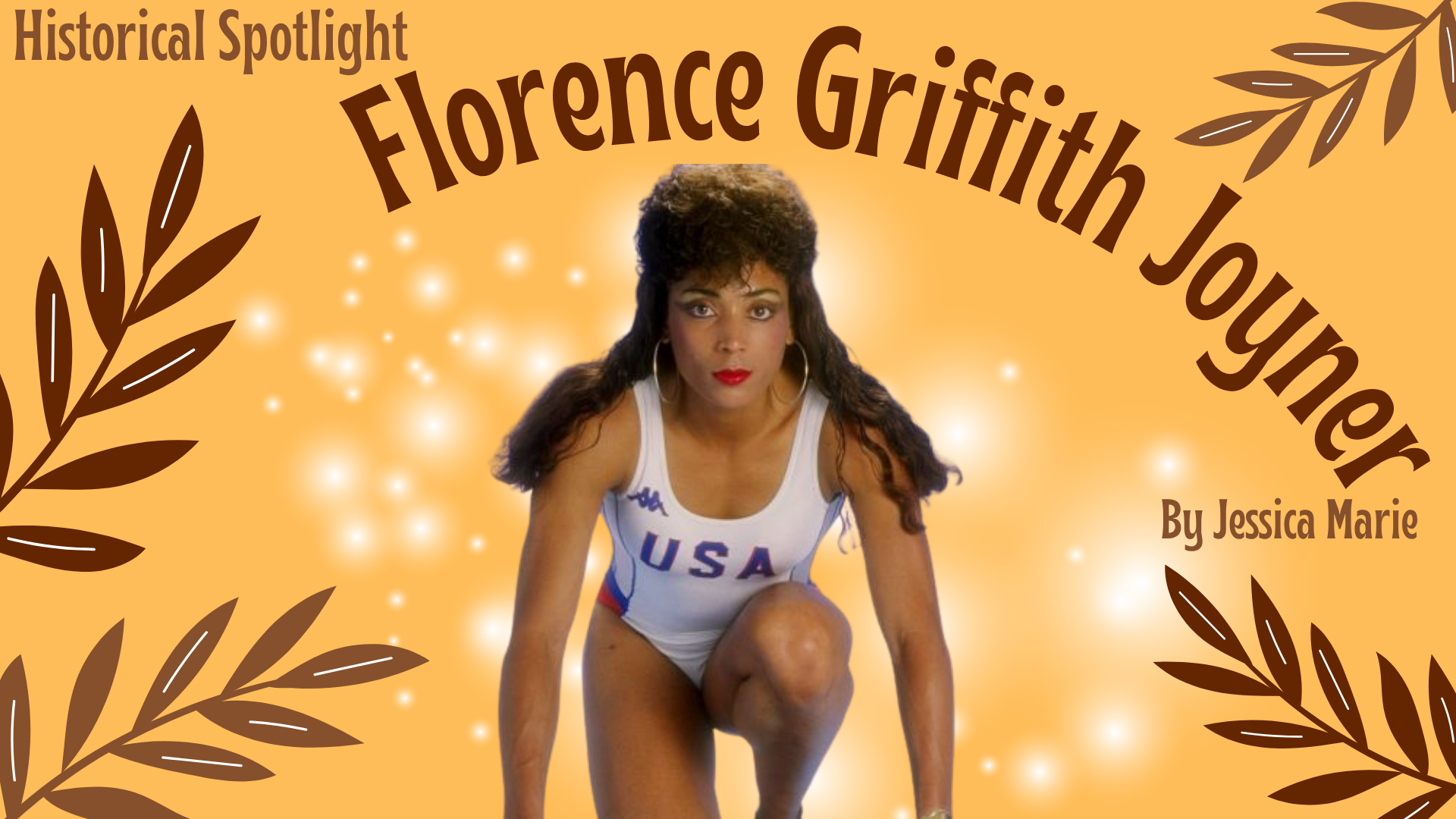

Within the last year or so, my husband and I have started keeping up with track and field as one of our must-watch sports. His favorite events are the long distance events while I’m partial to the sprinters and relay teams. We watch running videos on YouTube, follow certain athletes on social media, and try to tune in whenever a race is on TV. It doesn’t matter if it’s professionals running for an Olympic gold, an elite marathon runner chasing a PR, or the NCAA Tournament in Oregon, we’re interested and invested in the results. Join me as we shine a Historical Spotlight on Flo Jo, the Black American track star who made history as one of the greatest sprinters to ever compete.
Florence Griffith was born on December 21, 1959 in Los Angeles, California to her parents Robert and Florence Griffith. She was the seventh of her parent’s eleven children and the family resided in the Jordan Downs public housing complex in Watts during her childhood. She was known by her nickname, “Dee Dee”.
She had an interest in sports from a very early age. When she was in elementary school, she joined the Sugar Ray Robinson Organization and started running in track meets on weekends. She won the Jesse Owens National Youth Games in back to back years when she was 14 and 15.
She also had an early interest in fashion and even persuaded members of her track team to wear tights with their uniforms. During her senior year of high school, she finished sixth at the CIF California State Meet and set high-school records in sprinting and long jump.
For college, she attended California State University and ran track under coach Bob Kersee. The program, which had numerous top, record-breaking athletes, won the national championship during her freshman year. During her sophomore year, she dropped out to support her family by taking a job as a bank teller.
Refusing to allow her talent and hard work go to waste, Bob secured financial aid for her and helped her transfer to UCLA in 1980. She went on to qualify for the 100-meter final at the trials for the 1980 Summer Olympics, but didn’t compete for the gold due to the US boycott. She graduated in 1983 with her bachelor’s degree in psychology.
Just a few months later, she finished fourth in the 200-meter sprint in the first World Championship in Athletics. The next year, she qualified for the Olympics with the second-fastest time in the Olympic trials. She competed well in the 1984 Games, taking home a silver medal.
She went down to running only part-time for a few years after the 1984 Summer Olympics, but still competed well. She won the 100-meter IAAF Grand Prix Final by running 11.00 seconds, but skipped the 1985 US National Championship. That same year, she returned to working at a bank and leaned into her other passions of styling hair and nails in her spare time.
She emerged as a cultural icon and helped bring loud, flashy, long, and unique nails into the forefront of society. Some thought her style was distasteful, but she never let them deter her from fully expressing herself.
Florence married her husband Al Joyner in 1987, who she met during the 1980 Olympic trials. That same year, she returned to running professionally and finished second in the 200-meter sprint at the 1987 World Championships. Her successful season led to her being ranked number two in the world for the 200-meter and number seven in the world for the 100-meter.
To prepare for the 1988 US Olympic trials, she worked hard to bring down her time. In the first race of the quarterfinals, she set a world record by sprinting the 100-meter in just 10.49 seconds. She holds the record still to this day. During the same Olympic trials, she also set an American record in the 200-meter with a time of 21.77 seconds.
In late July 1988, she decided to search for a new coach who could provide her with more personal attention. She was also unhappy with the lack of sponsorship and endorsement opportunities and felt that she needed to pursue a different personal manager who would promote her a little more aggressively. She left UCLA for UC Irvine and decided that her husband would serve as her full-time coach.
By that time, her nickname Flo-Jo rang bells and she was favored for titles at the 1988 Summer Olympics. In the 100-meter final, she ran 10.54 seconds. In the 200-meter semifinal, she set the world record of 21.56 seconds and then immediately broke it in the final by running 21.34 seconds. She also ran and won the 4 x 100 meter relay and finished second in the 4 x 400 meter relay.
She won three gold and one silver medals during the 1988 Olympics. At the time, she held the record for the second most medals won by a female track and field athlete during a single Olympics.

Many naysayers accused her of using performance enhancing drugs for her incredible improvement. She denied the allegations and credited her physical changes to a new training program that focused more on lower-body strength. She never failed any drug tests even after being singled out for increased, rigorous testing.
In February 1989, she announced her retirement from racing. She won the James E. Sullivan Award of 1988 as the top amateur athlete in the United States. She also won the 1988 World Athletics Award for women.
Free from her racing obligations, she and Al welcomed their daughter Mary Ruth Joyner into the world on November 15, 1990. The family lived by the motto “if you try, try again” as a testament to the incredible dedication and commitment they had as Olympic champions. With all of her new free time, she leaned into her passions and business opportunities outside of sprinting.
Unable to deny her raw talent and outspoken personality, she rose even more in popularity and became a role model to many young girls who wished to be just like her. She was a pop culture icon who stayed relevant even past her time competing through endorsement deals, acting, and designing.
Her endorsement deals were particularly profitable, quickly making her a millionaire. She also signed a deal for a Barbie-like doll in her likeness. In 1989, she designed the basketball uniforms for the Indiana Pacers. She even made a few appearances on popular soap operas and television shows over the years. She was also chosen to serve as co-chair of the President’s Council on Physical Fitness from 1993 to 1998.
In 1996, she announced that she was returning to competitive athletics. She wanted to set the 400 meter world record and trained tirelessly for the US Olympic trials. Unfortunately, tendinitis in her right leg prevented her from achieving her goal.
Throughout her career, she was known for her bold fashion style. She single-handedly popularized the “one-legger” racing outfits. She was never afraid of bright colors and often wore lime green and purple with lightening bolts or other symbols. She designed many of her outfits herself and preferred unique looks that helped her stand out.
Her beautiful, long, vibrant nails also played into her bold style. During the 1988 Olympic trials, she rocked four inch nails with tiger stripes before switching them to fuschia. For the actual Olympics, she went more patriotic by painting them red, white, blue, and gold, but extended the length to six inches. Since most sprinters at the time avoided wearing accessories, Flo was authentically herself by showcasing her long hair, long nails, and jewelry.
If you look at the field during a women’s 100, 200, or 400 meter event, you’ll spot many women who are now able to express themselves and their creativity all because Flo-Jo was brave enough to be herself during a time when it was highly discouraged.
On September 21, 1998, she died in her sleep at just 38 years old after suffocating during a severe epileptic seizure caused by a birth defect. Her autopsy found that she had a congenital vascular brain abnormality that made her predisposed to seizures. She either had or had been treated for seizures in 1990, 1993, and 1994.
She was inducted into USA Track & Field’s Hall of Fame in 1995. The elementary school she attended as a child was renamed in her legacy. She was also named Woman of the Year for 1988 in Time magazine’s 2020 list of the most influential women of the past century.
Flo’s life was cut short because of an extremely rare circumstance. It’s incredible that she was able to achieve such a great career and set world records that people are still trying to break. Florence remained herself while pursuing her passions and showcased her effortless style, poise, talent, and dedication.
If you enjoyed this musing, I’d love to hear your thoughts. Like, comment, share, and subscribe so you don’t miss what’s next!
Signed,
Jessica Marie

