

Historical Spotlight: Daniel Hale Williams
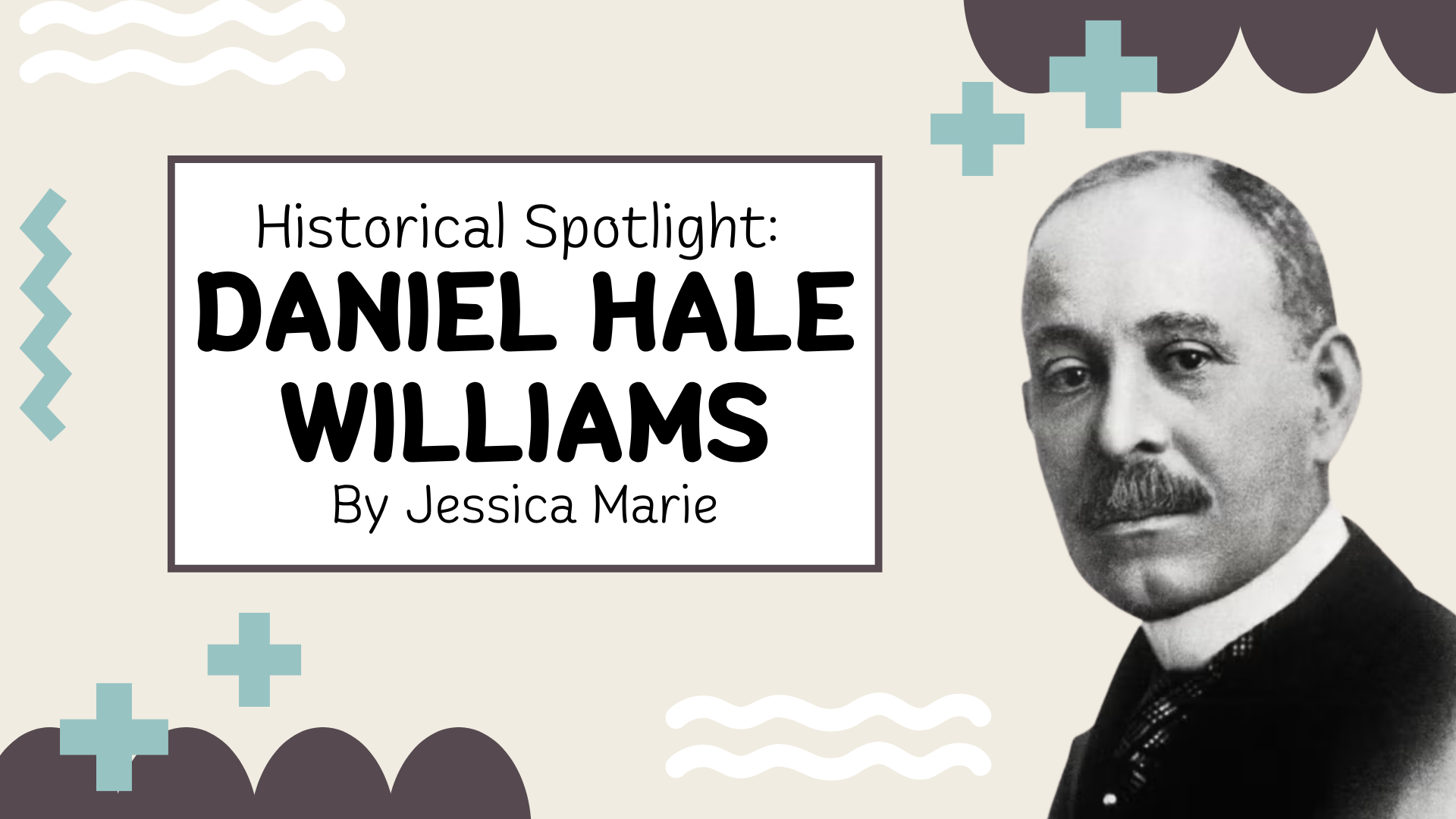

Historically, the healthcare system has been a luxury that often skipped Black Americans. From forced hysterectomies to mutilated bodies, we have been the subjects of many inhumane studies, procedures, and experiments that have led to a long-lasting distrust of the medical system. For a majority of us, we like to rely on holistic medicines and look to nature for healing ailments whenever we can. Join me as we shine a Historical Spotlight on Daniel Hale Williams, the Black American doctor who made history as the first surgeon to ever successfully perform open-heart surgery.
Daniel was born on January 18, 1856 in Hollidaysburg, Pennsylvania to his parents Daniel Jr. and Sarah Price. While his paternal grandmother was of Scotch-Irish descent, his paternal great grandfather came from a long line of Black Americans that were designated ‘other free’ that went all the way back to the 1790 census.
He was his parents’ fifth child and had one brother and five sisters. The family moved to Annapolis, Maryland during his childhood, but unfortunately, his father died of tuberculosis when he was just nine years old. His mother had to split up the family by sending some of his siblings to live with relatives who could better care for them.
Daniel was originally sent to live with a shoemaker in Baltimore, Maryland, but ran away to rejoin his mom in Rockford, Illinois. After a few years, he moved to Wisconsin, reconnected with one of his sisters, and opened his own barber shop. He became inspired by a local physician in the area and decided to try his hand in the medical field.
He studied under Henry Palmer, an American physician and educator who served as a Union Army surgeon in the Civil War, for two years. In 1880, he began his formal education at Chicago Medical College, now known as Northwestern University Medical School. Mary Jane Richardson Jones, a well-known activist and leader in Chicago’s Black community, paid for his schooling.
He graduated in 1883 with a Doctor of Medicine and opened a private medical practice in Chicago soon after. He also worked as an anatomy demonstrator at Northwestern from 1885 to 1888 and was even selected as an instructor at the free clinic on campus. In 1887, he was appointed to the Illinois State Board of Health and became an attending physician at the Protestant Orphan Asylum to help combat an outbreak of cholera.
In 1891, he founded the Provident Hospital in Chicago to increase the Black community’s access to health care. The facility was the first Black American run hospital in the United States and provided a training residency and school for doctors and nurses.
While the hospital was integrated from the very beginning, the focus was always about helping Black patients and Daniel accomplished this by providing a path for other Black Americans to break into the medical field. He endorsed Emma Ann Reynolds to Northwestern University Women’s Medical School which helped her become the first Black woman to receive a Doctor of Medicine from the school in 1895.

Just two years after opening his hospital, he made history by becoming the first Black American to successfully perform open heart surgery. On July 10, 1893, Daniel operated on a patient named James Cornish to repair a knife stab wound in response to continued bleeding, cough, and other symptoms of shock. He didn’t have the modern luxuries of penicillin and blood transfusions available and had to perform a second procedure to drain fluid, but the patient successfully recovered and left the hospital after about 50 days.
After his groundbreaking procedure, he was named the illustrious surgeon-in-chief of Freedman’s Hospital in Washington, D.C. and held the title from 1893 to 1898. He was also named to the Illinois Department of Public Health in 1897 and worked hard to improve medical and hospital standards in the state.
Outside of his work as a surgeon, he was also a Professor of Clinical Surgery at Meharry Medical College in Nashville, Tennessee. He focused on creating more hospitals that served Black Americans thoroughly and with care. In 1895, he co-founded the National Medical Association for Black doctors, which has grown tremendously over time. In 1913, he broke history again by becoming a member and, subsequently, the only Black American doctor in the American College of Surgeons.
He married his wife, Alice, in 1898 and the couple enjoyed 26 long years together before she passed in 1924. He died seven years later on August 4, 1931 from a stroke. He was 75 years old.
Dr. Daniel’s successful open-heart surgery helped progress medicine during a time when there weren’t a lot of modern life-saving tools available. The work was often uncharted, sometimes fatal, and very difficult. Heart-related surgery wasn’t widely accepted in the medical industry until World War II when surgeons were forced to improve their methods in repairing severe war wounds.
While Daniel didn’t get the credit he deserved while he was actively practicing medicine, he has since been recognized for his pioneering role in improving cardiac surgery. He advocated for competent resources for and in the Black community, inspired other Black people that they too could become great doctors and nurses, and built organizations, hospitals, and educational infrastructure that has withstood the tests of time.
If you enjoyed this musing, I’d love to hear your thoughts. Like, comment, share, and subscribe so you don’t miss what’s next!
Signed,
Jessica Marie

