

Historical Spotlight: Thomas Bradley
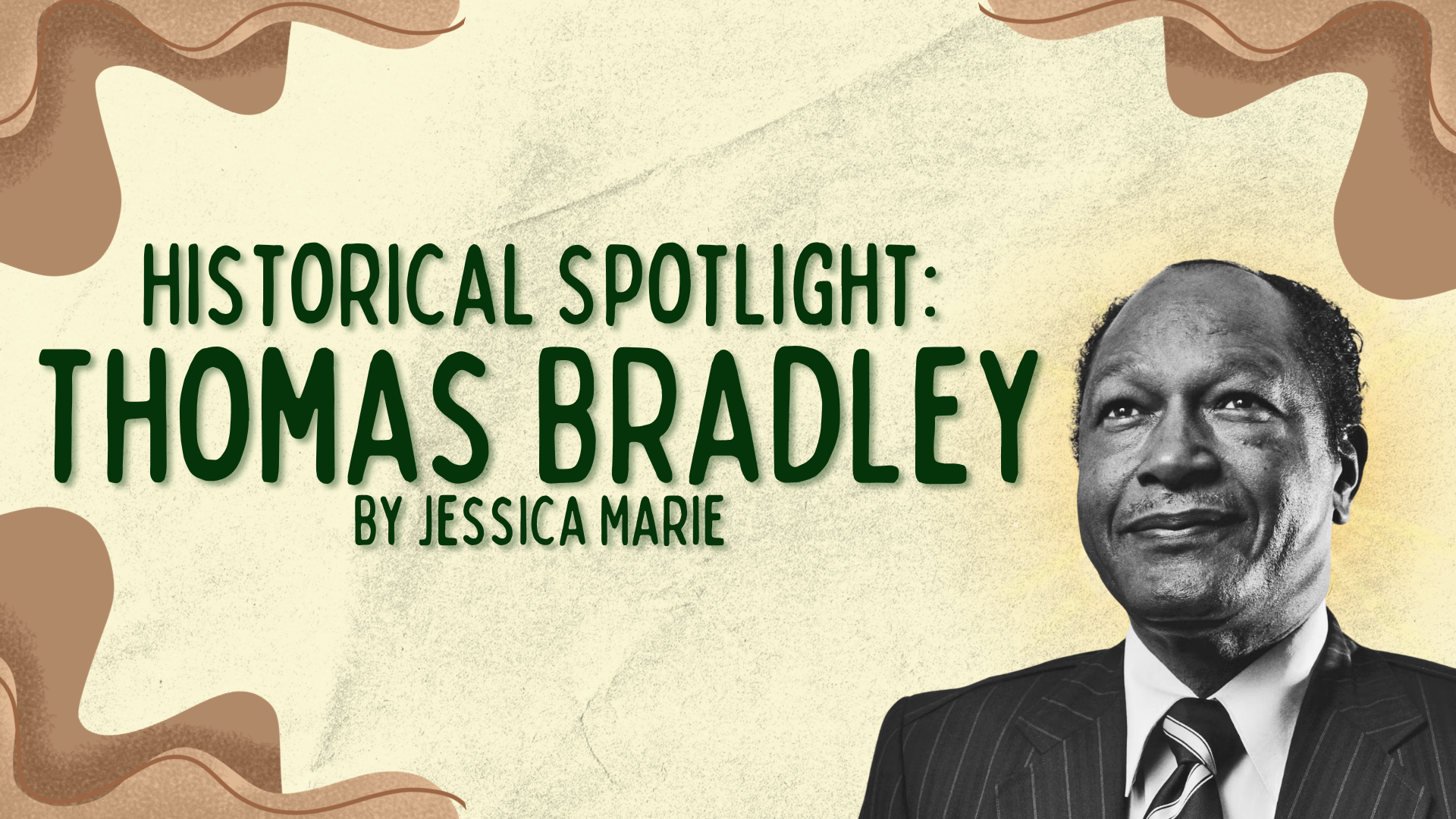

Sometimes, it’s hard to find your passion. You usually go through your childhood trying any and everything to figure out what you gravitate towards. While some people realize their life’s calling early, some have to go through trial and error to truly understand what they enjoy. It’s a luxury when your passion can align with your career or even help others along the way. Join me as we shine a Historical Spotlight on Thomas Bradley, the very first Black mayor of Los Angeles who addressed issues of disparity and ushered in much needed change for the city.
Thomas was born on December 29, 1917 to his parents Lee Thomas and Crenner Bradley. His mom and dad were poor sharecroppers who lived in a small town called Calvert, Texas. As a way to give him and his four siblings a chance at a better life, the family moved to Arizona to pick cotton and then again in 1924 to the Temple-Alvarado area of Los Angeles. His dad found work as a Santa Fe Railroad porter while his mom was a maid.
During his school years, he was the first Black student in his high school to be elected president of the Boys League and the first to be inducted into the Ephebians national honor society. He also excelled at track and field, which allowed him to attend UCLA in 1937 on an athletic scholarship.
After his college experience broadened his political and social knowledge, he joined the Los Angeles Police Department in 1940 and became one of 400 Black officers out of 4,000 total policemen in the department. He experienced racism and discrimination since Black officers were pigeonholed into only policing a predominantly Black community or working traffic downtown. Black officers were forbidden to work with a white officer until as late as 1964.
While working on the police force, Tom attended Southwestern University Law School. He retired from the police department in 1963 and began his practice as a lawyer. He also decided to become the president of the United Club, a liberal, reformist group part of the California Democratic Council, and start his journey into politics.
Tom became the first Black American elected to the City Council after getting elected to the 10th District seat on April 15, 1963. He saw his position as a way to bring groups together and wanted to establish a human relations commission for the city.
He stayed on the council for six years before choosing to run for mayor in 1969. He lost against the incumbent despite having significant endorsements from the Los Angeles Times and having a substantial lead in the primary. His name was smeared by his opponent who questioned his ability to fight crime and insinuated that he would open LA up to Black Nationalists.
He struggled to get the support of powerful downtown business interests but the redevelopment plan that passed in 1974 and inclusion of business leaders on influential committees helped him gain their backing. In 1973, he won the election and became the first Black American mayor of Los Angeles.
He served for 20 years and made history by having the longest tenure. He helped develop the satellite business hubs at Century City and Warner Center, effectively contributing to the city’s financial success. Thomas served as mayor when the city hosted the first profitable Summer Olympics in 1984 and saw LA become the second-most populated city in the United States.
He was also a strong supporter of public transit and was the driving force behind the construction of LA’s light rail network. He worked to build a comprehensive rail system and also pushed for expansion of Los Angeles International Airport. The terminals in use today are part of his legacy.
He decided to run for Governor of California in 1982 and 1986, but lost both times to the Republican candidate. He was the first Black American ever to head a gubernatorial election in the state.

Tom lost the 1982 election by only about 1.2%. He was leading in the polls going into election day and some news organizations even projected him as the winner before all the votes were properly counted. The very close circumstances gave rise to the term the “Bradley effect”, which refers to a tendency of voters to tell interviewers or pollsters that they are undecided or likely to vote for a Black candidate, but then actually vote for their white opponent.
Even though he was considered a liberal, he understood that business prosperity would create jobs and lead to stability for the entire city. Initially, the voters agreed with him, but as air pollution and traffic congestion increased, commercial development threatened residential neighborhoods, and conditions in the Santa Monica Bay worsened, he lost support. The 1992 Los Angeles riots also tanked his approval ratings.
He also alienated some voters after supporting a controversial oil drilling project near the Pacific Palisades and because of his reluctance to condemn Louis Farrakhan. Some of his key supporters lost their City Council seats, making it even more difficult for him to accomplish initiatives.
Tom decided to leave his office as mayor in 1993 instead of running for a sixth term. After his time as mayor ended, he continued practicing law and joined the office of Brobeck, Phleger & Harrison, which specialized in international trade issues. He was also active as a Prince Hall Freemason.
He married his wife Ethel Arnold on May 4, 1941. The couple had two daughters named Lorraine and Phylilis and unfortunately lost a third who died unexpectedly on the day she was born. Given the racial implications of the time, the couple had to go through a white intermediary just to purchase their first house in Leimert Park simply because it was an all-white neighborhood.
In March 1996, Tom had a heart attack and underwent triple bypass surgery. He experienced a stroke shortly after that affected his ability to speak. On September 23, 1998, he was admitted to a hospital to be treated for gout. Unfortunately, he suffered another heart attack on September 29th and was pronounced dead at 80.
Throughout his career, Thomas worked to create coalitions amongst the diverse group of residents that called LA home. He was the first modern liberal mayor, breaking the previously conservative mold. He even cut funding to the LAPD several times, but was unable to actually reform it.
He’s considered the third-best mayor in America since 1960 and the ninth-best to serve between 1820 and 1993. His life experiences gave him the gall to fight against the racist system and improve conditions in LA. He opened the door for other aspiring Black politicians to have a direct hand in change.
If you enjoyed this musing, I’d love to hear your thoughts. Like, comment, share, and subscribe so you don’t miss what’s next!
Signed,
Jessica Marie

