

Historical Spotlight: DJ Quik
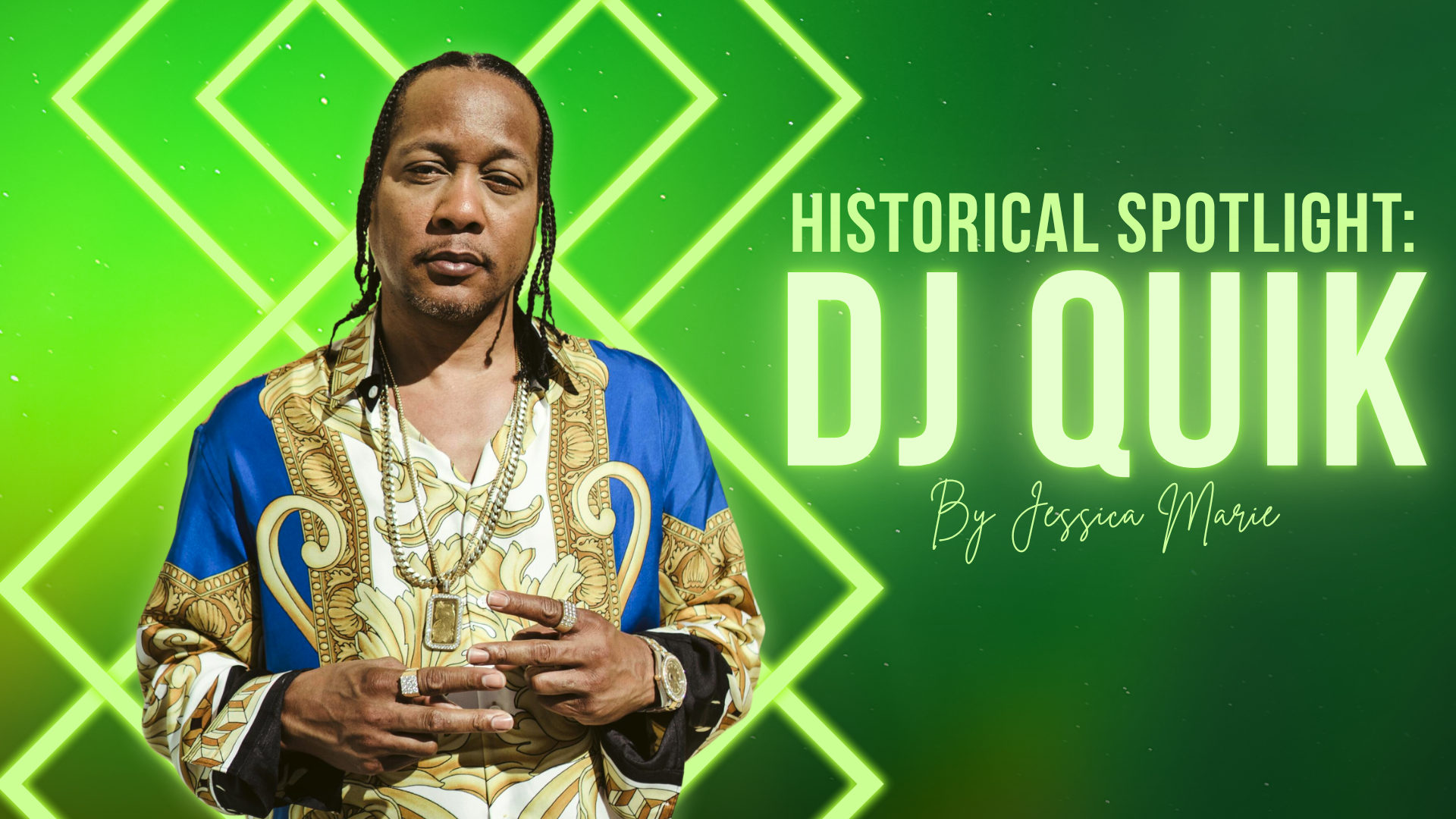

I love listening to music, mainly because of the vast options, unique artists, and incredible vocal and musical performances. The numerous different genres ensure that there is something for everyone, no matter your background, environment, or personal tastes. Artists, producers, and musicians have shaped the industry by embracing their unique flair, opening doors for others aspiring to make it big, inventing new genres, and breaking into spaces that weren’t originally meant for them. Join me as we shine a Historical Spotlight on DJ Quik, a legendary producer who not only influenced West Coast rap in the ‘90s but continues to be a major force in the music industry today.
DJ Quik, whose real name is David Marvin Blake, was born on January 18, 1970 in Compton, California. He was inspired by funk and soul artists from a very early age and naturally gravitated toward rich, layered sounds that he eventually infused into his signature style.
One of his biggest influences was Roger Troutman, founder of Zapp, who introduced David to his favorite production element, the talkbox, an effects unit that blends vocals with instruments. He quickly adopted it as one of his trademarks and it has survived time as a defining element of his production.
Sometimes referred to as Da Quiksta, he chose his stage name DJ Quik as a testament to how quickly he could produce songs. After receiving a turntable for his 8th grade promotion, he started selling homemade mixtapes and released The Red Tape in the late 1980s. To get exposure, he also started DJing shows around Southern California.
Unfortunately, he became a member of a prominent gang and dropped out of high school at just 16 years old. Around that same time, his mom lost her home due to foreclosure and moved to Louisiana. David chose to stay in Compton and was homeless for about three years before catching a major break.
During that time, he continued to release his mixtapes and gained a strong local following. He eventually caught the attention of major record labels including Profile Records and Ruthless Records. He chose to sign to Profile Records in the summer of 1990 and represented the label’s first six-figure signee. It’s reported that he later regretted his contract with Profile Records after being offered an advance of $1 million by Eazy-E, founder of Ruthless Records.
His debut album Quik Is the Name was released in 1991 and was led by his two top 20 R&B singles, “Tonite” and “Born and Raised in Compton”. The album performed well, reaching number 10 on the album charts and was certified Platinum by the RIAA. That same year, he produced 2nd II None’s debut album which sold more than 350,000 copies in its first nine months of release.
Not only did Quik make a name for himself as an artist, but he quickly gained attention and respect as a competent producer. This momentum helped him collaborate with many big name artists like Snoop Dogg, Suga Free, Dr. Dre, 2Pac, Nate Dogg, and many others over his career.
His second album, Way 2 Fonky, was released in 1992 and was certified Gold within three months. That same year, he co-produced with Eazy-E the debut album for Penthouse Players Clique Paid the Cost.
Gearing up for his next project, he decided to work with Suge Knight again, co-founder of Death Row Records and a very prominent, key person in gangsta rap’s commercial success in the 1990s. They originally worked together in 1988 and David was even signed to Suge’s independent label, Funky Enough Records, before he signed with Profile Records. They tried working together again in 1993, but it didn’t last long.
His third album, Safe + Sound, was released in 1995 and reached number 14 on the Billboard 200 chart. It featured 2nd II None, Kam, Playa Hamm, and Hi-C. Suge Knight is credited as the executive producer of the album and the project gave David a chance to produce tracks for 2Pac, Snoop Dogg, and others who were peaking at the time.
He actually was signed to Death Row Records for a short period of time but never released an album with the label. He had a major run, producing 2Pac’s All Eyez On Me and Snoop Dogg’s Dogg Food and Tha Doggfather. Even though many of his tracks went uncredited, he has fond memories from this time in his life.
Branching outside of rap, David produced a track on Tony! Toni! Tone!’s fourth album released in 1996, helping it to sell over a million copies. He also worked with Shaquille O’Neal to produce his third album You Can’t Stop the Reign.
Throughout his production work, he was keen on identifying talent and actually discovered Suga Free in 1997. David produced his debut album Street Gospel, helping it reach number 28 on the Billboard R&B albums chart. Despite it not achieving commercial success, it was well loved by underground rap fans in California and is still respected as a street classic.
David released his fourth album Rhythm-al-ism in 1998. The album was certified Gold in 1999 and featured guest appearances by Nate Dogg, AMG, Snoop Dogg, and Suga Free. That same year, he expanded and produced for other heavy hitters like Deborah Cox and Jermaine Dupri.
In 2000, he released his fifth album Balance & Options and had a huge part in producing Gap Band’s Y2K: Funkin’ Till 2000 Comz. Unfortunately, he was dropped as an artist from Profile Records after it was acquired by Arista Records in 2000.
Despite the setback, he continued producing for artists including Janet Jackson, Kurupt, Big Skye, Will Smith, Talib Kweli, and others. Suge Knight even attempted to sign Quik as the in-house producer for Death Row Records in 2001, but the deal fell through.
In 2002, he released his sixth album Under tha Influence, but was plagued by personal, business, and record label problems that made him almost retire. He was frustrated with his 11-year contract terms and felt like he wasn’t reaping the benefits of his hard work.
He decided to push through the issues and in 2003, worked with Jay-Z to produce on The Black Album. That same year, Chingy also enlisted Quik to produce for his debut hit album Jackpot. He produced the drums for 50 Cent’s breakout single In Da Club and also produced on Ludacris’ fifth album The Red Light District in 2004.

Finally being free of his contract, he created his own label, Mad Science Recordings, and released his first independent album titled Trauma in September 2005. The project chronicled the struggles he faced in his musical career and sold over 100,000 copies.
In late 2007, he formed the group the Fixxers with AMG. Choosing to temporarily drop DJ from his stage name, he rapped as simply Quik on the album. The pair signed a deal with Interscope Records for their album Midnight Life, but the album was illegally leaked before it was released.
On June 21, 2006, he was convicted of assaulting his sister and was sentenced to five months in prison. He was found guilty of pistol-whipping her for extorting him. Despite the fact that she tried to pull a grimy stunt involving her brother, he had to serve his term and was released early in October 2006. While an unfortunate circumstance, that time in his life allowed him to reflect and clean up some negative habits, people, and situations.
Refusing to be held down for long, Quik released his eighth album The Book of David in 2011. The album had features from Ice Cube, Bun B, Jon B., Dwele, and others. It debuted at number 55 on the US Billboard 200 chart, number 5 on the Top Rap Albums chart, number 4 on the Top R&B/Hip-Hop Albums chart, and number 4 on the Independent Albums chart.
In April 2016, David released a collaboration EP with Problem that included features from The Game, Wiz Khalifa, and more. Just a year later in 2017, they released the project into a full-length collaboration album with extended features and songs called Rosecrans.
Similar to the leaked album with AMG, not every project Quik has worked on has come to fruition. Some like The Kingdom Come by King Tee never got released while others were scrapped before they were finished.
When David first hit the scene, it was common for rappers and artists to have beef. Sometimes the conflict stemmed from real life issues while other times the beef was fabricated to boost record sales.
Quik was involved in a six year long feud with MC Eiht and his group Compton’s Most Wanted. The beef started from a lyric on DJ Quik’s debut mixtape and was influenced by the two being part of rival gangs. Over time, the pair threw shots back and forth through song lyrics and music videos, but by 1998, the beef fizzled out and they were able to reconcile.
He’s a living legend and one of the reasons why the G-funk style of West Coast hip-hop really took off. G-funk, AKA gangsta funk, started on the West Coast in the early 1990s and drew upon the synthesizer-heavy 1970s funk sound of Parliament-Funkadelic. It helped define West Coast rap by effectively distinguishing it from the East Coast rap scene. Popular albums like Dr. Dre’s The Chronic, Snoop Dogg’s Doggystyle, and 2Pac’s All Eyez On Me embody the unique genre.
Over his successful career, he’s made a name for himself that has withstood the test of time. Beyond music, he’s dabbled in acting and appeared in three movies and three TV shows. He lives a quiet life with his wife, Alicia Hill, and three children.
DJ Quik is a rapper and producer that has changed the landscape of music and has inspired many generations to follow in his footsteps. He’s still making fire beats, following his dreams, and being a musical pioneer. His legacy and impact on the industry is undeniable and he’s worked through strife to achieve his goals and dreams.
If you enjoyed this musing, I’d love to hear your thoughts. Like, comment, share, and subscribe so you don’t miss what’s next!
Signed,
Jessica Marie

