

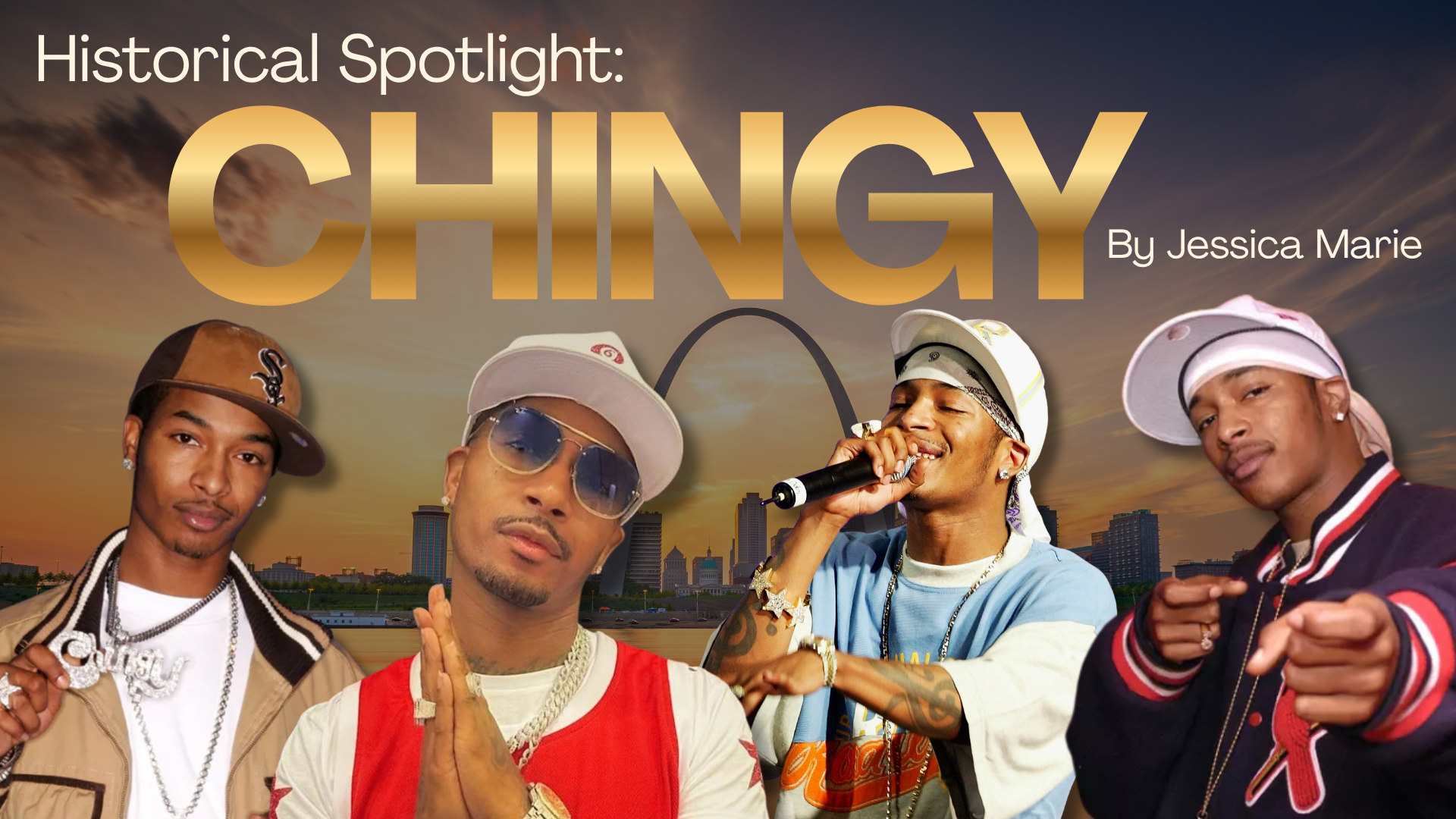

As we inch closer and closer to the turn of another decade, I love being able to look back on old movies, TV shows, and music because it’s always a nostalgic trip down memory lane. When I was in elementary and middle school, I watched movies like Mean Girls and have seen firsthand how those iconic sayings have been incorporated into pop culture. Similarly, I used to sing songs like Mrs. Officer by Lil Wayne when my mom would pick me up from school and every time I hear it now, I get transported back to those simpler times. Join me as we shine a Historical Spotlight on Chingy, one of my favorite early 2000’s rappers who has maintained his spot in my rotation for the past 20 years.
Howard Earl Bailey Jr., formally known as Chingy, was born on March 9, 1980 in St. Louis, Missouri to his parents Howard Earl Bailey Sr. and Vernita Crawford. Him and his parents, along with his two brothers and a sister, lived in a rough neighborhood and were often surrounded by crime and poverty. Music was his positive outlet and he began writing lyrics and recording his raps by the time he was 9 years old.
Unfortunately, he also got involved in street activity from an early age and was even sentenced to three months in a juvenile detention center when he was 12 for stealing cars. Once his bid was over, he continued his illegal behavior and allowed his life to head down a negative path. He was 17 years old when he finally got his wake up call after almost getting shot twice. He decided from then on to turn a new leaf, distance himself from the violence, and pursue his music career.
He created the St. Louis group, Without Warning, with M.G.D. and Mysphit and originally chose H Thugz as his stage name. The group saw local success and released a self-titled album with the record label 49 Productions. Howard later changed his stage name to Chingy as a play on words for money, which stuck for the rest of his career.
In 2002, he was discovered by Ludacris and his manager who quickly signed him to their label Disturbing tha Peace. That same year, Chingy opened for fellow St. Louis rapper Nelly during his tour. Pressure built between the two from Chingy feeling like he was slighted in the tour’s promotion and Nelly feeling like Chingy didn’t give credit to his humble beginnings and everyone who helped him sign his first record deal. Nelly responded by dropping a verse on his song “Another One”, but Chingy took it as a diss track and recorded “We Got” in response.
After his management team worked out a deal to distribute through Capitol Records, Chingy’s debut album Jackpot was released on July 15, 2003 and featured heavy hitters like Snoop Dogg, Murphy Lee, I-20, Trina, Jermaine Dupri, and others. It produced the hits “One Call Away” and “Holidae In” and was certified Platinum within a year of its release. Thanks to the success of the album, Chingy’s song “Right Thurr” also saw a major boost in popularity and reached as high as number two on the Billboard Hot 100 chart.

His second album, Powerballin’, was released on November 16, 2004 and peaked at number 10 on the chart. It again featured top artists including Lil Wayne, R. Kelly, Bun B, Janet Jackson, Nate Dogg, David Banner, and others. It sold over one million copies and was certified Platinum in March 2005.
A few years later, Chingy released his third album, Hoodstar, on September 19, 2006. The iconic single “Pulling Me Back” featuring Tyrese paved the way for the album to debut at number eight on the album chart. The second single, “Dem Jeans” featuring Jermaine Dupri, also contributed to the album going gold.
The beef with Nelly continued until 2006 when the pair were finally able to sit down and talk things through. Imagine my surprise 20 years later when I finally realized that those two were going at each other through hit records. Clearly I was too young to peep game because my mind was blown when I figured it out.
In 2007, he left Capitol Records and rejoined Disturbing tha Peace, which had by then become part of Def Jam. He was unhappy with how his previous record label was promoting their urban artists and felt that he didn’t have the best team to market and sell his work.
On December 18, 2007, his fourth album, Hate It or Love It, was released and featured appearances by Amerie, Timbaland, Trey Songz, Bobby Valentino, Rick Ross, and Anthony Hamilton. It debuted at number 84 on the Billboard 200 chart and only sold 30,000 copies.
On September 7, 2010, his fifth album, Success & Failure, was released. After stepping away from the mic for more than a decade, he released his sixth album, Chinglish, on June 16, 2023. In between his album releases, he toured with fellow legends like B2K, Ginuwine, and Mya, leaned into his other passions, and welcomed his two sons and two daughters into the world.
Outside of rapping, Howard dabbled in acting and made his film debut in 2003 with his role in Fromage 2003 and even appeared in Scary Movie 4 in 2006. He made his TV debut in 2005 with his roles on My Wife and Kids, the George Lopez show, and One on One.
To give back to the young Black adolescents who grew up in neighborhoods similar to the one he grew up in, he started the Chingy for Change Foundation to educate and empower the youth to become positive community leaders through development and mentorship.
While Chingy’s rise to stardom began more than 20 years ago, he has withstood the test of time and his hits have remained immediately recognizable. Whether you’re reminiscing about the theme song for NBA Live 2004, listening to an early 2000s music playlist, or rewatching one of your comfort shows, his music is bound to take you on a trip down memory lane. Chingy carved his own lane while remaining true to himself and showcasing his St. Louis flare.
If you enjoyed this musing, I’d love to hear your thoughts. Like, comment, share, and subscribe so you don’t miss what’s next!
Signed,
Jessica Marie

