

Historical Spotlight: Bruce’s Beach
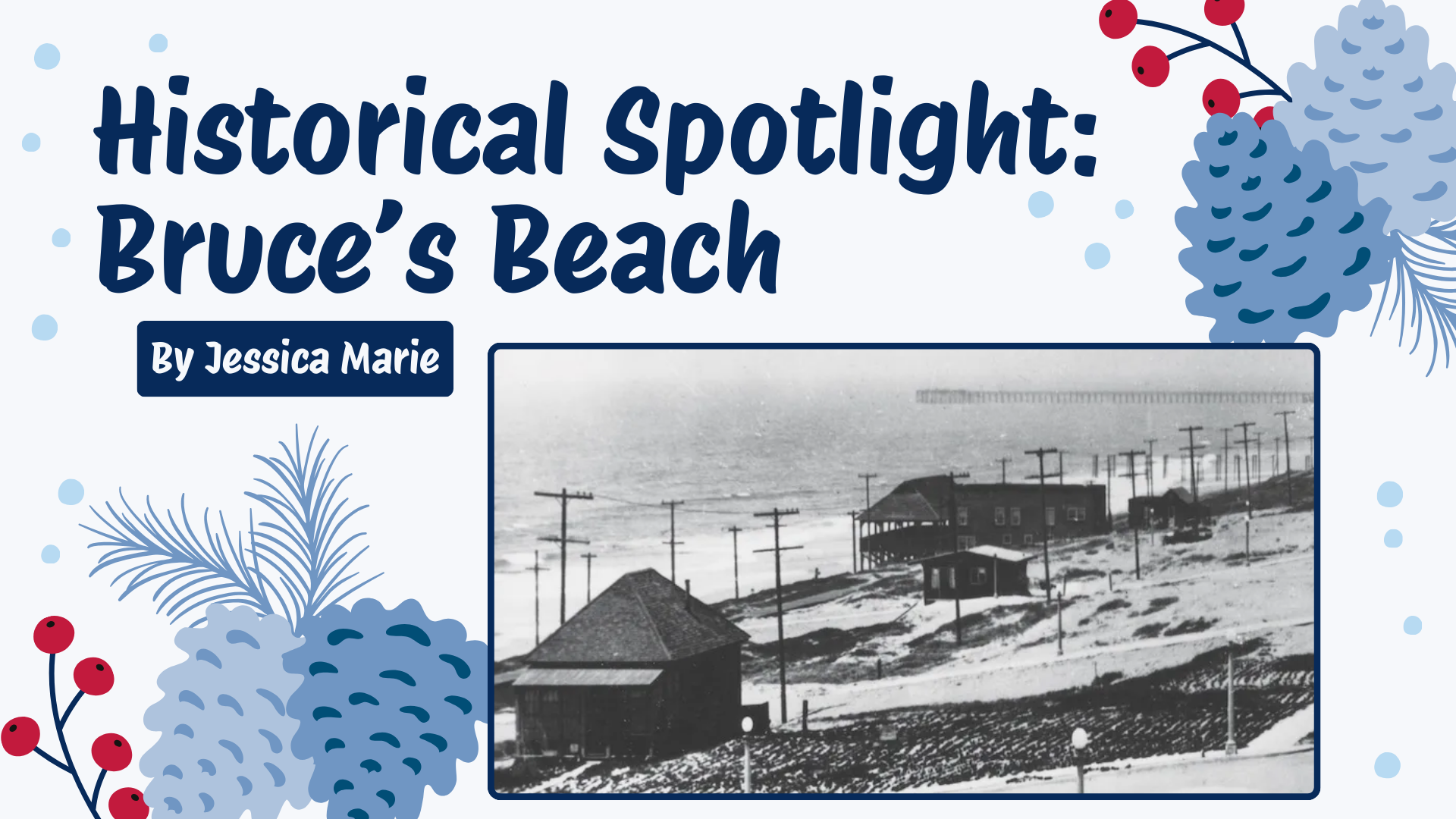

Black Americans have always struggled to gain a foothold economically, socially, and politically in America. From the evil act of slavery to discrimination, generations have had to fight tooth and nail just to have some semblance of peace. Even when smart business owners abided by segregation laws, their organizations were often undermined and sabotaged simply because of their success. Join me as we shine a Historical Spotlight on Bruce’s Beach, a successful Black beach resort in California that was unjustly taken by eminent domain.
Bruce’s Beach was opened in 1912 by Willa and Charles Bruce. It was named in honor of Willia and was located in present day Manhattan Beach in Los Angeles, California. The pair opened it to combat the confines of segregation and provide a safe space for Black Americans to enjoy the ocean. As time went on, it became more and more popular and featured a resort, lodge, cafe, and dance hall. Black people traveled from near and far to enjoy the accommodations.
Unfortunately, in 1924, the city of Manhattan Beach used eminent domain to close it under the guise of redeveloping the area into a public park. Eminent domain, also known as land acquisition of private property for public use, has always been a negative tactic used against Black Americans. Instances like Oscarville being taken to create Lake Lanier and other egregious acts have reduced the overall wealth of the Black community and have often displaced deep rooted communities.
The practice still happens and you’ll often see it during road expansions. If a municipality decides to take private property for the sake of public use, there’s really not much that can be done. While you can sue, the city usually has more than enough legal resources to play paperwork games and still take the property when all is said and done.
Many older Black communities, especially those in the Deep South, have owned their properties for generations. This financial independence in itself is a threat because it signifies a community that can stand on its own without government interference. The ancestors worked hard to build their houses brick by brick and eminent domain is just one sneaky way to negate that effort.
Bruce’s Beach was originally purchased for $1,225 from an LA real estate broker named Henry Willard. It was in a perfect location and provided close access to nearby Peck’s Pier and Pavilion, a section of Santa Monica State Beach known as the “Ink Well”, and the Pacific Beach Club in Orange County. Manhattan Beach was a predominantly white area and the locals didn’t approve of Bruce’s Beach being a safe haven for Black people.
By the 1920’s, Los Angeles’ population increased and property values grew exponentially, hurting the Black people in the area because of the increased racial tension constantly targeting them. Locals wanted to force them out and they used eminent domain proceedings to do just that. Founder of Manhattan Beach, George H. Peck, didn’t outright condemn segregation, but he did create barriers to direct Black out of town visitors to Bruce’s Beach instead of the other beaches, often forcing them to walk a further distance to avoid his property.
In 1927, the city took control of the land from the Bruce family and tore down the building under the guise of creating a city park. Bruce’s Beach wasn’t the only business affected, as other surrounding properties, especially those that were Black-owned, were also destroyed. Willa and Charles sued for $120,000 and, in 1929, received a meager settlement of $14,500.

Some of the property seized was transferred to the state of California in 1948 to create Manhattan State Beach. By 1950, the area still sat unused and city officials worried that family members would sue again. A park named Bayview Terrace Park was finally constructed in the 1960s after the land sat vacant for decades. In 1995, the state transferred a portion of land back to the county, helping the county own the entire block.
In 2006, Mayor Mitch Ward, the city’s first and only Black elected official, spearheaded the motion to rename the park and commemorate the history of the area. The city officially acknowledged its history of racial discrimination and renamed it Bruce’s Beach in March 2007.
In an effort to return the stolen property to its rightful owners, Kavon Ward, a Manhattan Beach resident founded an advocacy coalition called Justice for Bruce’s Beach in June 2020. Just a few months after its founding, the organization held a rally and march to apply even more public pressure.
In October 2020, the Bruce’s Beach Task Force was created to provide recommendations and resolve opposition from an anonymous group that claimed racism was used to grab power in the area. The task force recommended a public apology be issued by the city, but some members of the city council feared an apology would lead to liability for Manhattan Beach. Instead, they approved and issued a statement acknowledging, empathizing, and condemning the city’s role in the racially motivated condemnation of properties in Bruce’s Beach.
The city also struggled with adequately memorializing the original Bruce’s Beach. There was a plaque placed in 2006 acknowledging Willa and Charles, but the Task Force recommended to update the language. The city council drug its feet in accepting the changes, and one member on the Task Force resigned in protest after becoming frustrated by the lackadaisical time-wasting from the city.
On April 21, 2021, the Los Angeles County Board of Supervisors voted unanimously to return the land to the Bruce’s family descendants after it was taken almost a hundred years prior. Due to a restriction from a series of land transfers that prohibited the county from transferring or selling the property, the California State Senate had to approve a bill on June 2, 2021 to finalize the return.
The two parcels of oceanfront land were officially returned to Willa and Charles’ great-grandsons Marcus and Derrick on June 28, 2022. After thinking things through, they decided to sell it back to the county for a hefty $20 million on January 3, 2023.
Even though the Bruce family were eventually given their land back, it’s a shame that they had to wait almost a century to see that wealth return. They, like many others, are owed reparations for the unjust taking of their land simply due to the blatant racism and discrimination by Manhattan Beach. If they were able to keep their land, they could’ve continued building their wealth and providing resources for the community and their future generations. However, systemic white supremacy knocked them down, forcing them to start from scratch time and time again.
If you enjoyed this episode, let me know by giving this video a thumbs up, leaving a comment, and subscribing to my channel. I’ll see you in the next episode!
Signed,
Jessica Marie

