

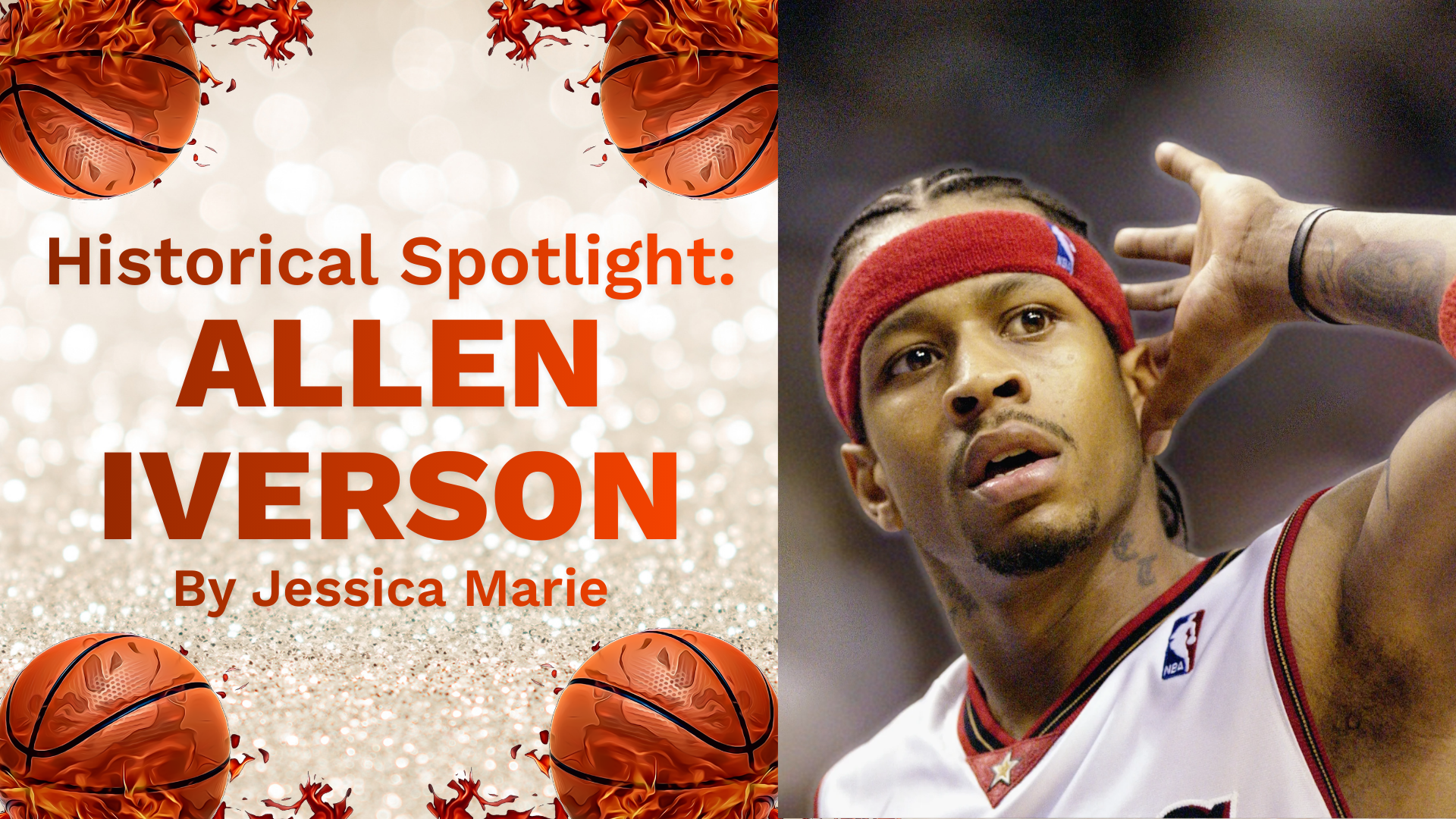

Like all things, basketball has morphed and evolved over time as players have entered the league and left their mark. Legends like Michael Jordan, Kobe, LeBron, and many others live on well past their playing days and spark debates online about who is rightfully the GOAT. While some players are loved for their on-the-court excellence, others have fought through negative press and stigma like Dennis Rodman, Latrell Sprewell, and Gilbert Arenas just to play the sport they love. Join me as we shine a Historical Spotlight on Allen Iverson and the influential impact he left on the league.
Allen was born on June 7, 1975 in Hampton, Virginia. His mom, Ann Iverson, had him at only 15 years old and was a single mother after his father chose not to be involved. He attended Bethel High School and played both football and basketball. He led both teams to Virginia state championships during his junior year and won the AP High School Player of the Year award for both sports. He played AAU basketball under “Boo” Williams and won the 1992 17-and-under AAU national championship.
On February 14, 1993, Allen was arrested at just 17 years old for allegedly hitting a woman with a chair at a bowling alley. It was a racially fueled altercation and AI and his Black friends were the only people arrested. He was convicted as an adult of the felony charge of maiming by mob, a rarely used Virginia statute that was designed to stop lynching.
He was sentenced to 15 years in prison with 10 years suspended. After spending four months in a correctional facility, he was granted clemency by the Virginia Governor and the Virginia Court of Appeals overturned the conviction two years later for insufficient evidence. Unfortunately, the system was trying to make an example of him as a young Black man. The public played a huge role in his release and there were many rallies and marches held for his justice.
Despite the extremely traumatic incident, AI focused on the positives that came out of the whole jail situation. He was able to complete his senior year of high school and, upon being released, was granted a full scholarship to Georgetown University.
During his first season, he won Big East Rookie of the Year and was named to the All Rookie Tournament First Team after averaging 20.4 points per game. He helped the Hoyas reach the Sweet 16, where they ultimately lost to North Carolina. During his second and last collegiate season, he led the team to the Big East championship and made an Elite Eight appearance before losing to Massachusetts.
He left Georgetown as the all-time leader in career scoring average at 22.9 points per game. He was named a first-team All-American and won the Big East Defensive Player of the Year award during both of his seasons. He declared for the 1996 NBA draft and was the first player under Coach John Thompson to leave Georgetown early for the league.
Nicknamed “the Answer”, Allen was selected with the 1st overall pick by the Philadelphia 76ers and left a legacy as the shortest first overall pick ever since he was only 6 feet tall. He chose to wear number 3 and in his first NBA game, he scored 30 points and had 6 assists, tying Willie Anderson for the third highest scoring by a rookie guard during his debut.
He also broke Wilt Chamberlain’s rookie record by having five straight games with at least 40 points. AI averaged 23.5 points, 7.5 assists, and 2.1 steals per game and was named the NBA Rookie of the Year. The next season, he and Larry Hughes were nicknamed “The Flight Brothers” for their above-the-rim and athletic play style. On January 26, 1999, Allen signed a six-year, $70.9 million max contract extension. He led the league by averaging 26.8 points, received his first scoring title, and was named to his first All-NBA First Team.
During his first playoff appearance, he started all ten games and averaged 28.5 points despite dealing with multiple nagging injuries. The next season, the team earned another trip to the playoffs where AI averaged 26.2 points, 4.8 assists, 4 rebounds, and 1.3 steals per game.
In 2000, he was selected to the Eastern Conference All-Star team for the first time, beginning his streak of 11 straight selections. He was the only player other than Shaq to receive an MVP vote that year. During the off-season, the 76ers actively tried to trade him because of tension, but the tentative deal with the Detroit Pistons ultimately fell through. He also recorded a rap single called “40 Bars” under his moniker, Jewelz, but was unable to release it due to controversial lyrics.
The next season, the team started hot on a 10-0 run. Allen was named a starter for the 2001 All-Star Game and won the game MVP. The Sixers finished the regular season 56-26, earning them the top seed in the Eastern Conference. AI averaged 31.1 points and 2.6 steals per game, earning him his second scoring title and the NBA steals title. His exemplary performance led to him being named the league’s MVP and he became the shortest and lightest player to win the award.
His teammates Dikembe Mutombo, who won Defensive Player of the Year, Aaron McKie, who won Sixth Man of the Year, and Larry Brown, who won NBA Coach of the Year, all contributed to the team’s success that year. They made it all the way to the Finals against the Shaq and Kobe led Lakers and were the only team to beat them during their 16-1 title run. Allen made history by scoring 48 points in his finals debut, the highest ever recorded.
During this iconic season, he started wearing a basketball sleeve during his recovery from a right elbow injury. Other influential players around the league started wearing them too and before long the trend caught on and spread as a fashion statement.
After the 2001 season ended, he partnered with Reebok for a 10-year $50 million contract that included $800,000 annually and access to a $32 million trust fund when he turned 55. He was named Vice President of Basketball in October 2023 and is involved in player recruitment, community initiatives, and athlete activations.
The team was hampered by injuries the next season and were unable to recreate their previous magic. AI averaged 31.4 points to earn his third scoring title despite the team finishing with a 43-39 record.
After they lost in the first round of the playoffs, Coach Brown criticized Allen for missing team practices and it was during his response that he coined his iconic phrase, “We sittin' here, I'm supposed to be a franchise player, and we in here talkin' about practice.” That moment continues to live on in pop culture and many people can still relate to how he felt.
The 2002-2003 season started off poorly, but the team was able to adjust after the All-Star break to make the playoffs with a 48-34 record. AI averaged 27.6 points per game to get them to the second round, but Coach Brown left the organization at the end of the season.

In the off-season, he signed a 4-year $76.7 million contract extension. The 76ers hired another coach, but his tenure was short-lived after not building any chemistry with his players. The interim head coach’s disciplinarian approach created tension for Allen, who missed a career high 34 games, leading to the 76ers missing the postseason for the first time since 1998.
The next season saw improvements under a new head coach and additions of Andre Iguodala and Chris Webber. On February 12, 2005, Allen scored a career-high 60 points after shooting 24 for 27 from the free throw line and recording 6 assists and 5 steals. He won his fourth scoring title by averaging 31 points and 8 assists for the year. He was also named co-captain of the 2004 US men’s Olympic basketball team.
The team changed head coaches again for the next season and AI averaged a career-high 33 points per game but the team missed the playoffs. He was fined and kept on the bench after arriving late to a Sixers’ fan appreciation night and home game finale on April 18, 2006. At the same time, trade rumors started swirling, even though he made it clear he wanted to stay a 76er.
After the first 15 games of the 2006-2007 season were abysmal, the organization refused to play him and decided to trade him to the Denver Nuggets. He ended his 10 year career with the 76ers with the highest scoring average in team history at 28.1 points per game and is second all-time on the points list at 19,583.
He made his debut with the Nuggets in December 2006 and had 22 points and 10 assists. During a game in January 2007, he was fined $25,000 by the league for criticizing a referee who he felt was calling the game personally. His thoughts were confirmed after the book, Personal Foul: A First-Person Account of the Scandal that Rocked the NBA, and a 60 Minutes interview came out years later that said certain officials working his games purposefully didn’t give him favorable calls as a way to “teach him a lesson.”
On March 19, 2008, he returned to Philadelphia and received a standing ovation from a sold-out crowd after scoring 32 points. On November 3, 2008, he was traded to the Detroit Pistons and switched to number 1. He scored at least 20 or more points per game, but lost playing time to Rodney Stuckey as the season went on. He was deactivated on April 3, 2009 due to his ongoing back injury.
On September 10, 2009, he signed a one-year $3.1 million contract with the Memphis Grizzlies but left the team after two months, unhappy at coming off the bench. He only played three games for the organization.
In December 2009, he returned to the 76ers and signed a contract at the $1.3 million league minimum salary for players with at least 10 years of experience. He played his first game back on December 7 and received another standing ovation from the sold-out crowd. He was forced to take time away from the sport to take care of his daughter, who was having a health scare. He played his last NBA game on February 20, 2010.
He played two years for a Turkish Super League team before returning to the States in January 2011 for calf surgery. He announced his official retirement on October 30, 2013. The 76ers retired his number 3 jersey on March 1, 2014.
He was inducted into the Naismith Memorial Basketball Hall of Fame in 2016 and joined the BIG3 league as a coach, captain, and player in 2017. In 2024, the 76ers unveiled a statue of Allen outside of their practice facility and the Virginia Governor even declared March 5 as Allen Iverson Day.
AI started dating his high school sweetheart Tawanna Turner when they were just 16 before getting married in August 2001. They have five children named Tiaura, Allen II, Isaiah, Messiah, and Dream. On March 2, 2010, Tawanna filed for divorce and it was finalized in 2013, but the couple has since reconciled and are back together.
He single handedly transformed the culture of the NBA and American sports by wearing his iconic braids, showcasing his preference for rap music, and repping his many tattoos. In fact, he was the first player in the league who rocked the ink, making it okay for others to follow in his footsteps and change the entire landscape of the sport.
AI wore his baggy jeans, jerseys, do-rags, and chains, effectively dismantling the league’s unspoken conservative dress code. Because he was highly influential and refused to conform, Commissioner David Stern implemented a mandatory business-casual dress code. Allen felt it was a personal attack towards him since he spearheaded the cultural shift that fans and younger players quickly adopted. Despite the threat of being fined, he held the line to force the NBA to embrace individuality and the mandatory dress code was quickly abandoned.
The style of the NBA changed thanks to the contributions of a fearless player who refused to be watered down. Instead, Allen Iverson forged his own path as one of the most influential basketball players and athletes in American culture. He was targeted for being a young Black man who wasn’t afraid to be himself, but he fought through adversity to achieve greatness. He left his mark on the NBA through his elite play and is a legend that will forever be remembered.
If you enjoyed this musing, I’d love to hear your thoughts. Like, comment, share, and subscribe so you don’t miss what’s next!
Signed,
Jessica Marie

